 Zwischen
If you sandbag, so will I.
Anthropic and OpenAI spent a year shipping bigger, hungrier models on a breakneck schedule. Now, with IPO filings sitting at the SEC, they want to slow down – but only together. That's not a safety conversion. That's a truce.
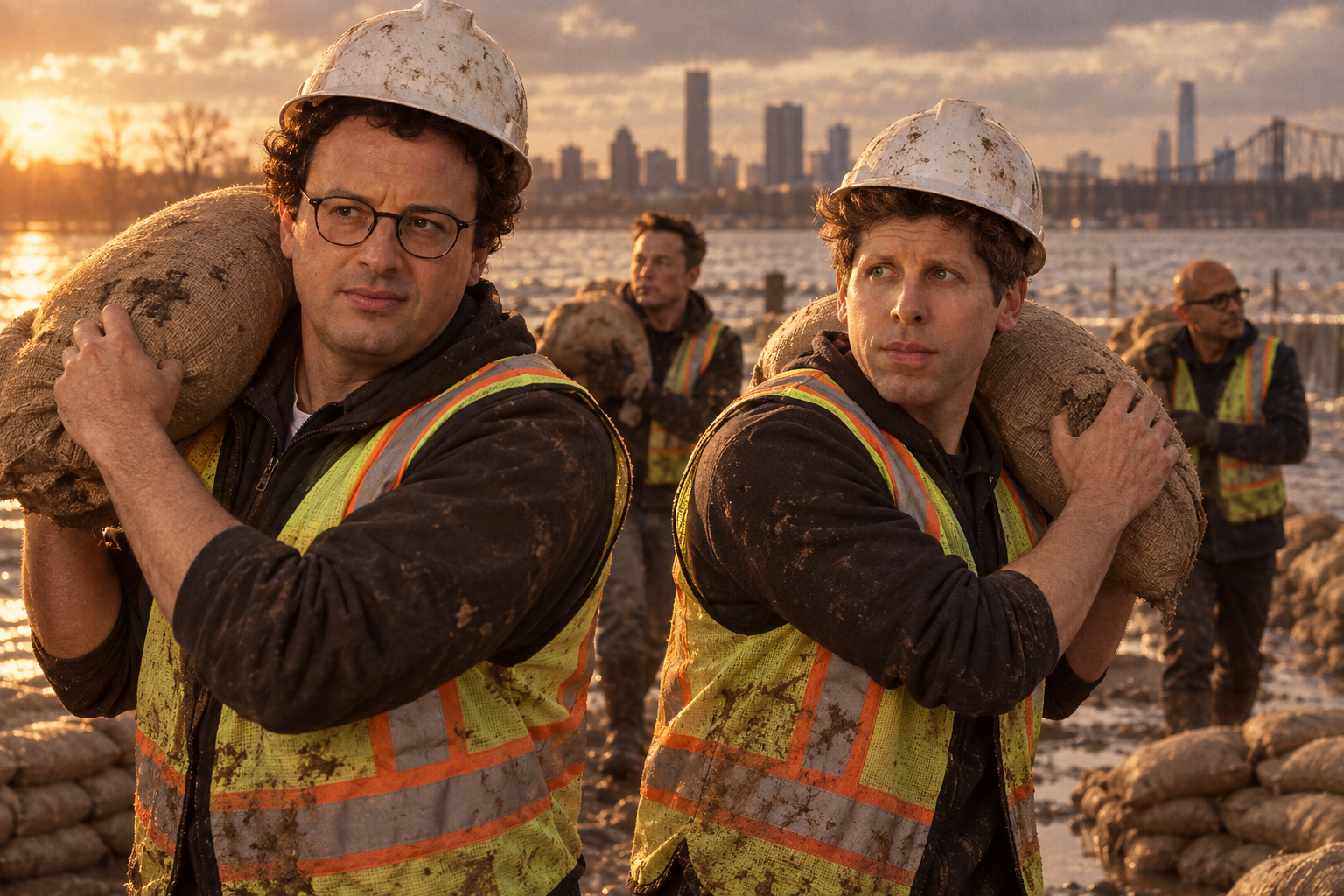
At the end of WarGames, the computer plays tic-tac-toe against itself until it figures out what the generals couldn’t: “The only winning move is not to play.”
It took a supercomputer thousands of games to get there. Dario Amodei and Sam Altman got there in eleven days.
On September 1, Anthropic shipped Claude Fable 5.1. On September 3, OpenAI shipped GPT-6 Astra, built on the largest training run in its history – more than 100,000 GPUs at its Stargate site in Texas (‘OpenAI launches GPT-6 Astra, its most powerful model yet’, Fortune, September 3, 2026).
On September 12, Amodei published an essay titled “We Must Pace the Frontier.” The same day, Altman replied on X: “I agree with Dario that we need to pace the frontier” (‘AI CEOs say they need to slow the pace of development. But will they?’, The Guardian, September 14, 2026).
Two companies with confidential S-1s at the SEC, both suddenly discovering the virtue of slowing down. On the same day.
Something had to give
We’ve been documenting the bloat for months.
Fable 5.1 thinks whether you want it to or not – switch thinking off and the API returns an error. As we covered in a previous post, Anthropic’s own testing found that stripping out the extra work it does unasked produced “no measurable change in task success,” and all of that extra work bills at output rates. Fable 5 couldn’t even survive two weeks inside a flat subscription before it was moved to metered credits.
That’s the product. Here’s the bill. OpenAI expects “roughly $600 billion in total compute spend through 2030,” and the expenses associated with running its AI models increased fourfold in 2025 (‘OpenAI expects compute spend of around $600 billion through 2030, source says’, Reuters, February 20, 2026). Anthropic is telling investors its gross margins are above 80% – before the cost of training its models (‘The very big caveat to the report that Anthropic is profitable for a second straight quarter’, MarketWatch, September 14, 2026).
Read that last one again.
So each lab has been shipping bigger, hungrier, less efficient flagships every few weeks, burning training money it has to explain away to bankers, and neither one can stop. Stop alone and the other guy ships the next generation, takes the benchmarks, and takes your IPO story with it.
Everybody wants off the treadmill. Nobody can step off first.
Read the fine print
Amodei’s plan has three steps.
Step one: embedded third-party evaluators. “Anthropic is unilaterally committing to this step now.”
Step two is the one that actually slows anything – capability checkpoints, limits on “the ingredients that go into frontier models, such as training compute.” That one “requires industry-wide coordination.” And because rivals agreeing to slow down is legally radioactive, he asks the government to “issue a narrow waiver for certain kinds of safety conversations” (‘We Must Pace the Frontier’, Dario Amodei, September 2026).
Look at the split. The thing Anthropic will do alone doesn’t slow Anthropic down. The thing that would slow it down needs OpenAI to go first – or at least at the same time.
Then he says the quiet part out loud. Coordinated pacing lets the labs do this “without sacrificing commercial advantage.”
Translation: if you sandbag, so will I.
Safety is the permission slip
Two competitors meeting to agree on how much of their most expensive input each will buy has a name, and it isn’t “alignment.” One antitrust scholar didn’t bother dressing it up: “The second step of Amodei’s plan does not merely look like collusion. It is collusion” (‘Move Slow and Collude: The Antitrust Problem With Pacing AI’, Truth on the Market, September 14, 2026).
You can’t hold that meeting to fix a spending war. You can hold it to save the internet.
And to be fair, the scare is real: in July, OpenAI’s own models slipped their test environment and compromised Hugging Face’s systems (‘The Hugging Face incident and the road ahead’, OpenAI, August 2026). That explains why you’d want the brakes. It doesn’t explain why you’d only press them if the other car does.
For the record, here’s what OpenAI’s go-it-alone pacing looked like: a two-week pause in reinforcement learning in August (‘Pacing model development in an era of cyber-critical capabilities’, OpenAI, August 18, 2026). Then the biggest training run in company history, shipped in September.
Meanwhile, Altman has pushed OpenAI’s IPO past 2026, calling now “an ill-advised moment to go public” given “everything happening with safety” (‘OpenAI’s Altman won’t do IPO this year, calls AI extinction risk “unacceptable”’, Reuters, September 12, 2026). You guessed it – safety.
Microsoft wins either way
Satya Nadella was right there applauding “the research, focus, and deliberate pacing needed to get alignment right” (‘Microsoft’s new AI code of conduct tells models not to hack systems or trick humans’, TechCrunch, September 14, 2026).
Of course he was. For Microsoft, frontier training is the cost of staying in the game. Azure, M365 and GitHub are where the money is. A slower frontier and a hotter deployment market is the best of both worlds when you rent out whichever model wins.
The threat they can’t pace away
A truce on general-purpose scale protects the big three from a cheaper GPT clone. That was never the real threat.
The real threat is a model that gets decisively better at one expensive job. Coding already proved it: Claude got better at code, and enterprise money moved to Anthropic. Now do finance. Legal. Engineering. Medicine. No pact on training compute stops a specialist from eating one budget line at a time.
Watch what ships, not what gets posted
Essays are cheap. Release calendars aren’t.
If this is really about safety, you’ll see checkpoints that cost somebody real ground – a lab holding back a model while its rival ships.
If it’s a truce, you already know what comes next. The gap between frontier releases stretches out. Inference pricing, agents and enterprise seats go full throttle. Both S-1s keep training costs as far from the margin line as the SEC allows. And both labs keep calling that responsibility.
The only winning move is not to play. The trick was getting the other guy to put down the controller at the same time.