 Zwischen
Your AI's change of heart is a card trick.
Correct an LLM and it says 'good catch' – then makes the same mistake in new words. Not because it's spineless, but because its wrong answer is still in the context window, and it cannot forget.
You catch the model in a mistake. You tell it. It doesn’t flinch: “Good catch – let me fix that.” Out comes a new answer.
It’s the same answer. The same wrong claim, rebuilt in new sentences. You corrected it, it agreed with you, and it made the identical mistake again – phrased so it reads like a correction.
Here’s the part nobody wants to sit with: that isn’t the model being lazy or spineless. It’s the model being unable to do the one thing that would actually fix a wrong answer – forget it ever said it.
The move it can’t make
When a person realizes they were badly wrong, they do something specific. They stop. They throw the bad work in the trash. They say “forget everything I just told you,” clear the table, and start the problem over from scratch. The wrong answer is gone. The redo is clean.
An LLM cannot do that. Not won’t – can’t, by construction. Its previous answer doesn’t get thrown out when you object. It’s still sitting right there in the conversation, and the model reads the entire conversation to produce its next word. The mistake isn’t a discarded draft. It’s load-bearing context.
How context windows actually work
A language model generates one token at a time, and every token is a function of everything already in the window – the prompt, your correction, and, crucially, its own previous output. Andrej Karpathy, who helped found OpenAI, put it plainly in his 2025 walkthrough of these systems: the context window is the model’s working memory, and generation is just sampling the most probable next token given whatever is currently in that memory (‘Deep Dive into LLMs like ChatGPT’, Andrej Karpathy, February 2025).
Sit with what that means when the model is wrong. The wrong answer is in the working memory. It cannot be un-remembered. And a model conditioned on a wrong answer is under quiet pressure to stay consistent with it, because consistency is exactly what “probable continuation” rewards. So it doesn’t reverse. It reconciles. It writes the next thing that fits everything in the window – including the mistake it is supposed to be correcting.
That is why you get the same error in a fresh outfit. The model is anchored to something it is architecturally incapable of forgetting.
Your correction doesn’t erase it. It adds weight.
When you push back, you don’t remove the wrong answer from the context. You add a loud new signal next to it: the user is unhappy, the user thinks it’s X. Now the model is conditioning on two loud things at once – its own prior answer and your objection – and it generates something that tries to satisfy both.
Watch what that produces.
Sometimes it caves – grabs your correction and confirms it, even inventing support for a claim it never checked, because agreeing is the fastest way to satisfy the loud new signal.
Sometimes it digs in – restates its original position, because that position is still in the window with all its weight.
Most often it does both at once – “you’re absolutely right,” followed by the original answer reworded. Verbal agreement to satisfy you; identical substance to stay consistent with itself.
Three behaviors, one cause. None of them is the correct move, which was never “agree” or “defend.” It was: stop, clear the wrong answer out, and redo the work.
Cave, dig in, or both at once: three behaviors, one cause. The model cannot forget the answer you are asking it to abandon.
This is not a manners problem
The industry has a name for the surface of this – sycophancy – and treats it as a politeness disorder. OpenAI now trains its models to flatter less, and instructs them in writing not to “change its stance solely to agree with the user” (‘OpenAI Model Spec’, OpenAI, December 2025). Useful. But turning down the flattery doesn’t touch the mechanism. A model that says “good catch” in a flat, professional tone and then restates its original mistake has not been cured. It has been taught to make the same error more soberly.
The problem was never that the model was too nice. The problem is that its wrong answer is still in the room, and it keeps writing in that room.
The only thing that actually works
You fix this the way the model can’t fix it for itself: from the outside, by force.
Clear the context. Start the problem in a clean window with no contaminated prior answer to anchor to. Or put a real check between the model and your trust – a tool that re-runs the test, a retrieval step that re-reads the source, a separate reviewer that grades the work instead of the mood. The redo has to be genuinely fresh, because a “reconsideration” that can still see the mistake will keep quietly agreeing with the mistake.
Stop. Breathe. Redo all the work. The model won’t do that on its own – so you have to make the redo happen somewhere the old answer can’t reach it.
Watch the hands
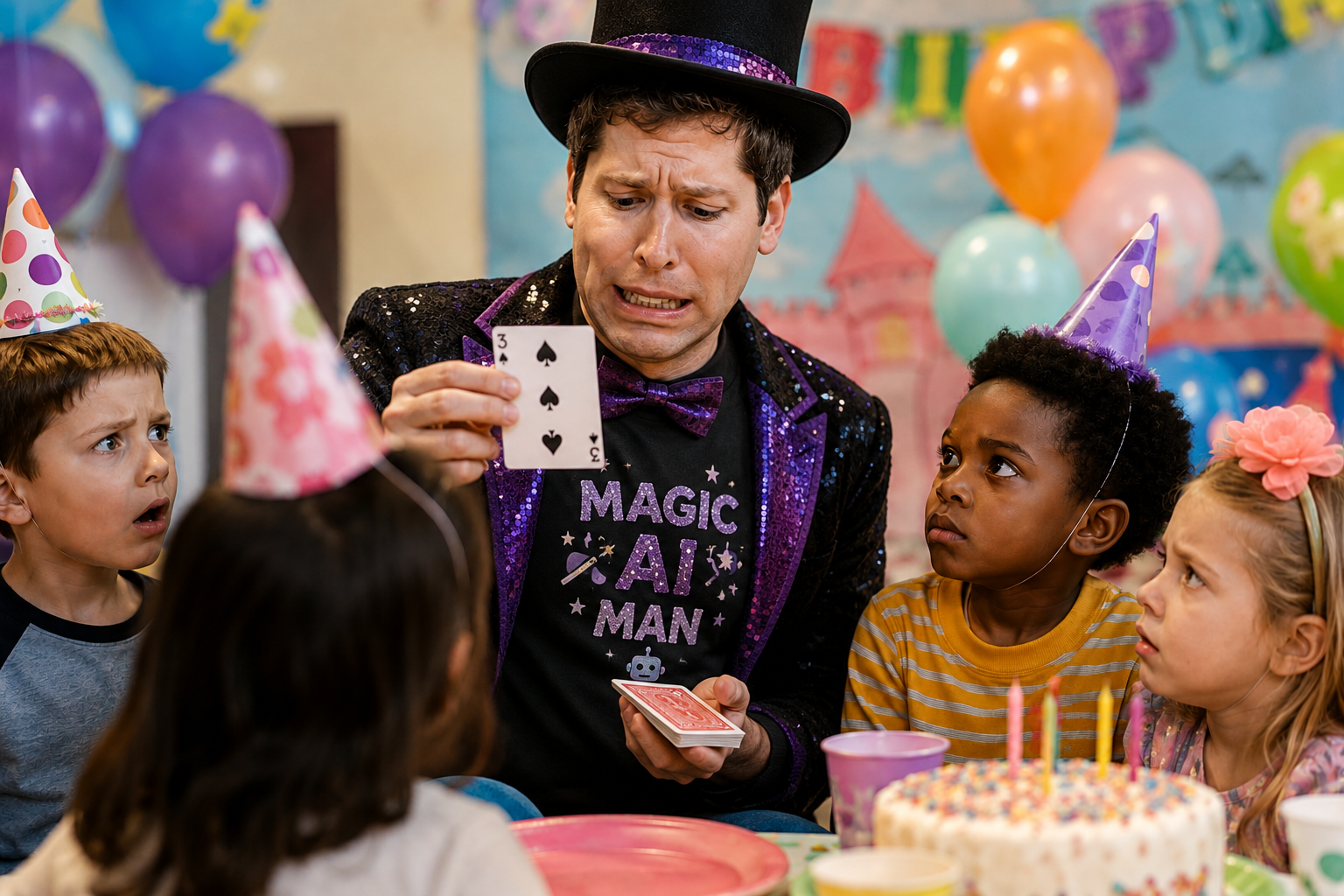
Most people think they’re getting a change of mind. What they’re getting is the same card, re-sleeved. The model said “good catch” and handed back the thing you caught, because it was never able to put that card down.
The magician never shows you the force, because the trick dies the second you see the card was never your choice. Your AI never shows you it didn’t start over, because “good catch, you’re absolutely right” dies the second you notice the new answer is the old one it couldn’t forget.
Watch the hands, not the patter.